
This was a wow trip. In the past there was a whole lot of guessing going on concerning the sizes and dimensions of the underground and submerged caves in Namibia. As they are so vast and deep, ordinary humans/divers could not adequately map the terrain.
Enter Sunfish, “a user friendly and person-portable Autonomous Underwater Vehicle (AUV) with field proven Artificial Intelligence (AI) and Simultaneous Localization and Mapping (SLAM).”
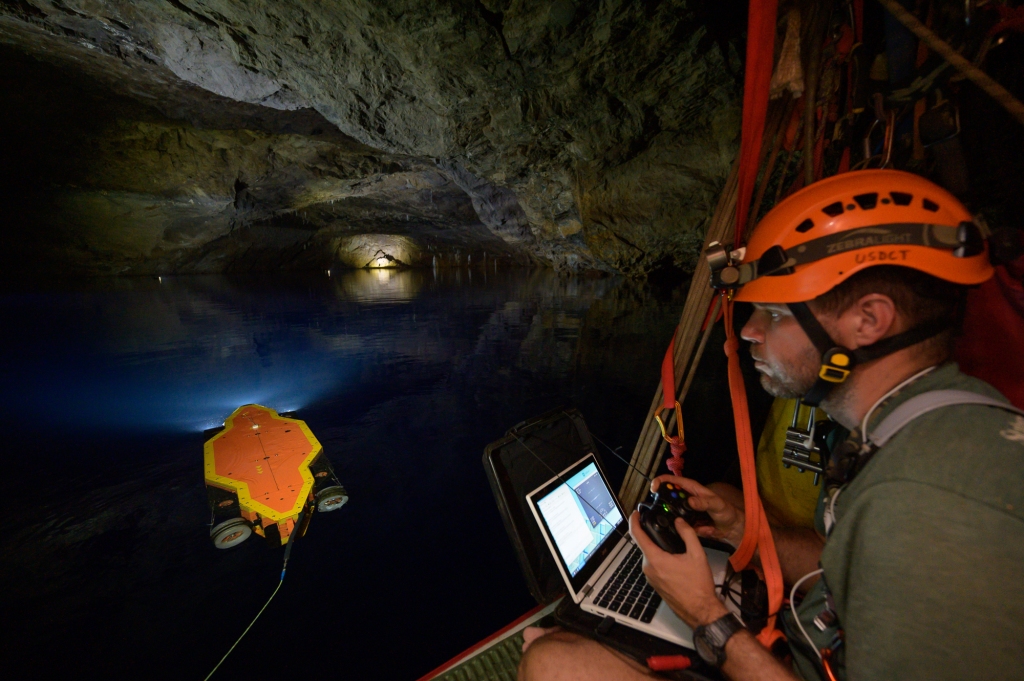
Years ago, Don mentioned to Bill Stone, the founder of Stone Aerospace, that we have some big caves in Southern Africa that needed exploration, and a couple of years ago an expedition was launched to visit three of the sites. Lake Guinas was an open sinkhole explored to (I stand corrected) 150 metres by divers. Harasib was a semi enclosed site explored to 162 metres. And Dragon’s Breath was a completely enclosed underground lake explored to 132 metres. Each site reconnaissance is worth its own story as each site had its own unique challenges, but this write-up only covers the trip briefly. We endeavour to write more about each site separately.
In a nutshell, the Sunfish gets programmed to go map a specific area using multi-beam sonar and come back to base station once the mission is completed. It can also be told to map another area while underwater. On this trip it was tethered with fibre-optic to transfer data back to the programmers in real time. It can also be and was on occasion driven with joystick controls.
Guinas was the first choice for a set-up site as the Sunfish had to travel to Africa disassembled. So, reassembling it and testing it where the surface was open and accessible to the support team was the way to go. A few programming glitches were sorted, the hole was mapped, and we pulled all the gear.

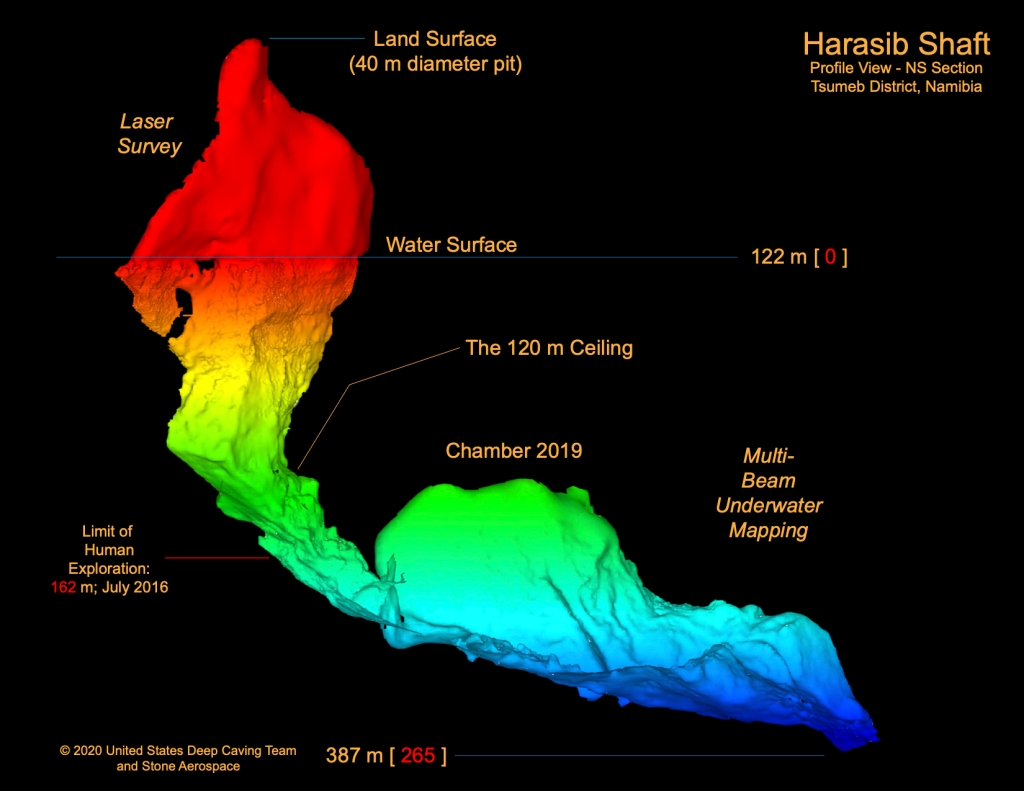
We went to what we deemed to be the second hardest site – Harasib. This was over a hundred meters drop to the water, so all equipment has to be lowered via a pulley system, and of course once done, brought back out again. Divers and surface support had to also go down the same route so SRT skills was a requirement. The Sunfish went to work. The first chamber went flawless, but then the tether got stuck between some stalactites in the shallow end. Don had some recovery work to do to free the Sunfish and at the same time not get entangled in the loops of fibre-optic cable that he was pulling form the stalactites.
Once freed, it went off to map the deep end, lost communications at just over 250 metres which was out of reach for even technical divers. There were quite a few worried programmers on the surface. This was a true test to see if the Sunfish could now come back from the deepest part of a cave on its own reconnaissance. That’s why the Stone Aerospace was out here – to test these scenarios, but I believe they would have preferred testing this scenario at a depth where Don could jump in and help if necessary. But at over 250 metres it was out of reach. It performed very well indeed, and a few breaths were let out when it surfaced.
The next site was deemed the most difficult. Mainly because of the many pitches and narrow openings to get into and back out of the cave. It took a lot of huffing and puffing to get Sunfish through some very tricky spaces to the underground lake. The subterranean lake is deemed the biggest non sub-glacial underground lake in the world. The surface part is a couple of football fields big, but the underwater part is so much more!
By this time the Sunfish was as happy as a fish in water and it did not take long to map the cave. What took most of the time though, were the photographers asking divers, top-surface lighting crew, and the Sunfish to go through their paces and pose for the cameras. Chilling work for the divers and reasonably boring for the lighting crew that had to hold lights at various angles. The shots they got was worth all the trouble though.

The short video I made gives you an idea of the trip. Don and I try and make the journey to and from our destination part of the experience. Gone are the marathon drives to get there and back again. We add stops and overnights in order to enjoy life and smell the roses along the way. I hope you enjoy the video.
Stone Aerospace is an aerospace engineering firm founded by engineer and explorer Bill Stone, located in Austin, Texas.
 Shexit